

Why Your Community App Feels Slow (And What “Native” Actually Means)


 ·
6 min read
·
6 min read
Open the app. Tap a tab. Wait.
There’s a half-second pause where nothing happens, then the screen finally fades in. A spinner appears for some reason. You scroll, and the list stutters. You tap a profile, and the back button doesn’t quite work right. Pull-to-refresh is just… missing.
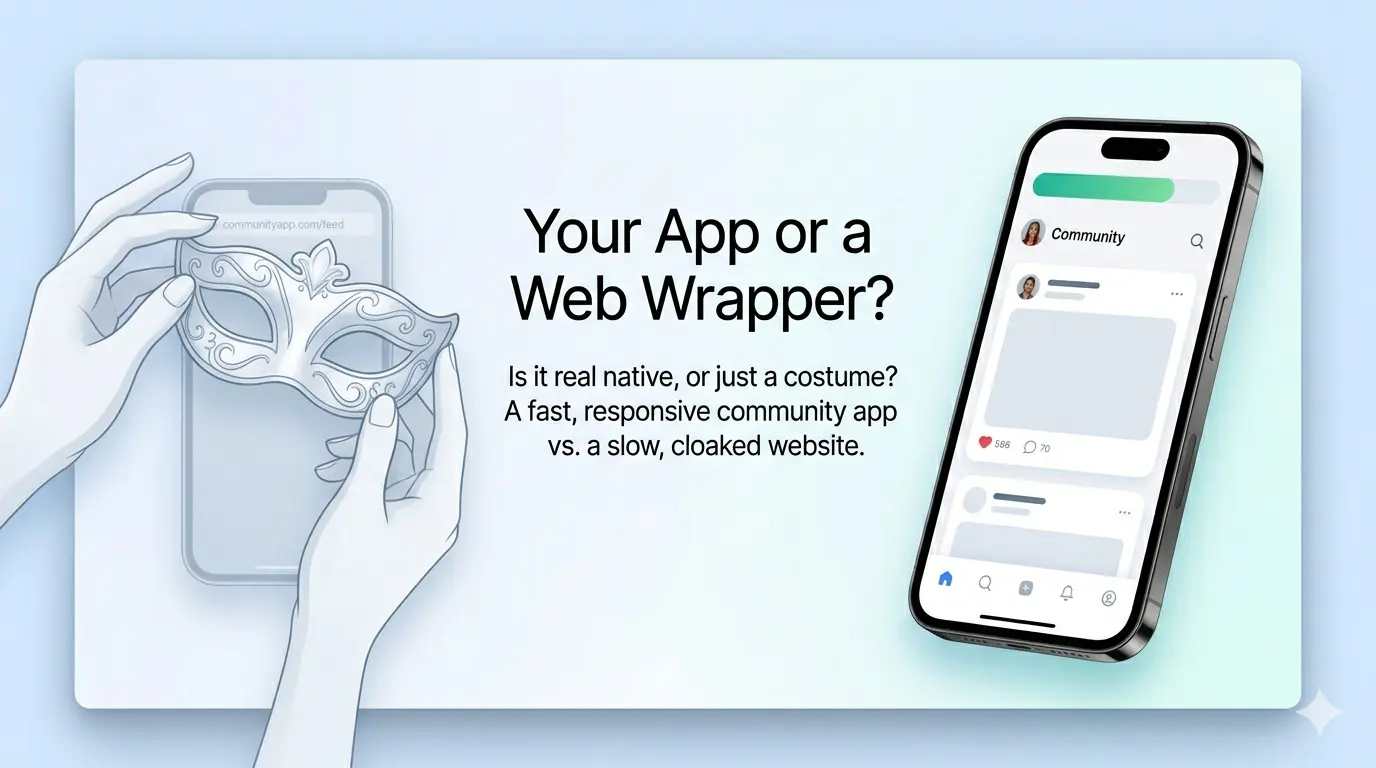
If any of that sounds familiar, your community app probably isn’t an app. It’s a website wearing one as a costume.
That’s not a metaphor. There are three very different things being sold right now under the words “community app,” and they’re wildly different despite sitting in the same App Store icon grid.
The three kinds
Native apps are written in code the phone actually understands — Swift on iOS, Kotlin on Android, or modern cross-platform frameworks like React Native that compile down to real native UI. When you tap a button, the OS draws the response itself. Animations run at 60 or 120 frames per second. Gestures feel right because they are the gestures the OS provides. Push notifications, biometrics, the camera, offline storage — all available, all fast. Discord, Coinbase, and parts of Microsoft Office all run on React Native. It’s not a compromise — it’s how serious mobile apps are built today.
Progressive Web Apps (PWAs) are websites with extra metadata that lets you “install” them to your home screen. They run inside a hidden browser engine. They’ve gotten better the last few years, but their push notification support is still more limited and less reliable than native — especially on iOS, where notifications only work for installed PWAs and don’t support the richer features of native push. They also live and die by your internet connection.
Update, October 2026: Fluent Community Pro now includes a web app of its own (version 2.8), with web push through the FluentNotify plugin (2.9). We compare it with a native app in A Fluent Community app: native, or the web app (PWA)?
Web wrappers (sometimes called “hybrid” apps) are the worst of both worlds. They’re a thin shell of native code whose only real job is to show a full-screen web view of your existing site. You scroll a website. You read a website. Every screen change is a fresh HTTP request. The only thing native about it is the icon on your home screen. This is what many “white-label community apps” actually are, even when nobody on the sales call says so out loud.
How to tell which one you have
Three quick tests, no technical knowledge required:
1. Turn on airplane mode and open the app. A native app should still load something — at minimum a cached version of your last-viewed screen, ideally a usable offline mode for content you’ve already seen. A web wrapper will give you a blank screen or a “no internet” error within a few seconds.
2. Pull down to refresh on the main feed. Does it feel instantly responsive, with the native iOS or Android refresh indicator? Or is there a fraction-of-a-second pause before anything reacts? Native apps respond to your touch the moment your finger moves. Web wrappers respond after the JavaScript catches up.
3. Tap a push notification. Does the app open directly to the right content — the post, the message, the comment? Native apps can deep-link to any screen instantly. Most web wrappers either dump you on the home screen or take a noticeable beat to navigate, because every screen change is essentially loading a new web page.
If your community app fails any of those tests, you’re paying for a web wrapper.
Why this hits community apps harder than other apps
A community app gets used differently than a shopping app or a news app. People open it dozens of times a day, often for only a few seconds at a time. Quick check. Quick reply. Quick scroll.
Those microsecond delays add up. When your feed takes a beat to load every single time, members open it less often. When push notifications are slow or unreliable, they miss the conversations they care about. When the back button doesn’t quite work, they get frustrated and close the app. And once a member’s habit of “open the app, check in, post something” is broken, it’s very hard to get back.
We watched this happen on our old platform. Engagement dropped, and we couldn’t tell whether it was us, our content, or our members losing interest. It turned out to be the app. People weren’t bored — they were just tired of fighting it.
What we did about it
The TBC App is fully native. It’s built on React Native and Expo — the same stack used by Discord, Coinbase, and parts of Microsoft Office. The UI compiles to actual iOS and Android components. Animations run at native frame rates. Gestures are real gestures. Push notifications are real push notifications that deep-link into the right post or message in the moment your member taps them. Cached content lives locally on the device so the app still works on flaky cell service.
It connects to your Fluent Community site through a real JSON API, not by loading the HTML of every page on demand. That’s why it’s fast. That’s why it feels like an app instead of a tab in disguise.
What “white-label” actually means in this space
There’s a wide gap between “you can change the colors and logo” and “you own the app.” Most of what gets sold as white-label in this space is the first one. You pay a monthly fee, and in return you get an app with your logo on the launch screen but otherwise identical to every other customer’s app. If you want a custom feature, you pay extra. If you want to change how something works, you usually can’t. If you stop paying, the app stops existing.
We’ve been on the wrong end of that for years, and we wrote about why we built our way out in the previous post. The short version: real ownership means you get the source code, you can modify it, and nothing you’ve built can be taken away from you on someone else’s whim.
The honest verdict
If you’re shopping for a community app right now, the questions to ask aren’t about feature lists. Feature lists are easy to write and hard to verify. Ask:
- Is it native, a wrapper, or a PWA? Make them tell you, in those words.
- Do I get the source code, or am I renting?
- What happens to my app if I stop paying?
- How quickly can a small bug be fixed and pushed to my members?
If the answers don’t make you feel good, keep looking.
You own your community. The app your members use every day should feel like it.